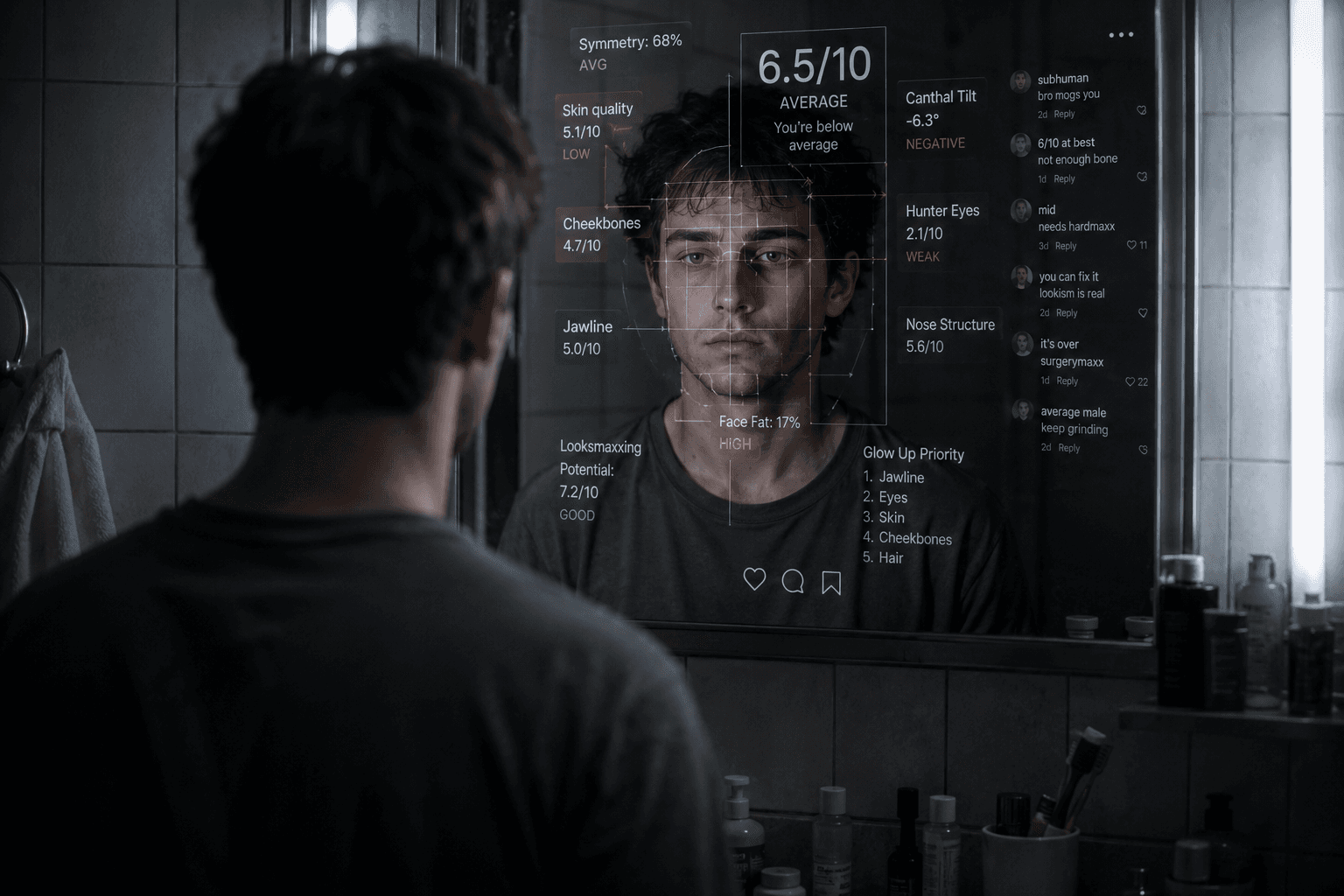
A 17-year-old standing in front of a bathroom mirror, rotating his head slowly, studying his jawline from every angle.
A TikTok comment section with three thousand replies arguing about hunter eyes.
Teenagers discussing canthal tilt like they are quoting a medical textbook.
Someone zooming into their own face at 2AM wondering if their genetics ruined their life.
Five years ago, almost nobody outside niche internet forums knew what looksmaxxing meant. Today it has billions of views on TikTok, its own communities with hundreds of thousands of subscribers, and a vocabulary so dense that new users need a glossary just to follow a thread.
Something happened here.
And the answer isn't vanity.
What Looksmaxxing Actually Is
The word is simple. Looks plus maxxing, as in maximizing. Optimizing your physical appearance to its highest possible ceiling.
It started in corners of the internet where men discuss dating, rejection, and what separates men who succeed romantically from men who do not. Bodybuilding forums. Lookism communities. Niche Reddit threads. Places where people were unusually blunt about how much appearance matters and unusually willing to quantify it.
Then it migrated to TikTok and Instagram, where it shed most of the darker ideology and kept the practical advice. Skincare routines. Gym programs. Mewing. Before-and-after videos.
There is a spectrum here, and where someone falls on it matters.
Softmaxxing is the entry point: gym, skincare, grooming, posture, sleep, fashion. Things that would have just been called taking care of yourself ten years ago. The advice is mostly sound. The framing is new.
Hardmaxxing moves into medical territory: rhinoplasty, jaw fillers, hair transplants, buccal fat removal. Irreversible. Expensive. Risky.
Extreme looksmaxxing is where it becomes genuinely dangerous: bonesmashing, near-starvation diets, obsessive facial analysis measured to the millimeter, and communities that function more like eating disorder forums than grooming threads.
Some of this is just modern male grooming. Some of it becomes psychologically dangerous.
The distance between those two poles is shorter than most people expect.
Why Looksmaxxing Exploded
The content exists because the demand exists. Understanding the demand is the real story.
Dating Apps Rewired Male Psychology
For most of human history, attraction was social and gradual. You met someone through mutual friends, at a workplace, at a party. They saw you in motion. Attraction built over time.
Dating apps collapsed that into a single image evaluated in under a second.
The mechanics are brutal for most men. Research consistently finds that match distribution on dating platforms is highly unequal, with a small percentage of men receiving the vast majority of attention. Whether or not any specific number holds across every app, the experience is consistent: near-zero matches, followed by an obvious conclusion.
Young men increasingly feel like they are competing in a global marketplace of attractiveness.
Not a local bar. A marketplace where your profile either clears a visual threshold in the first second or disappears forever.
The rational response to that environment, if you accept its premise, is to optimize the product.
Which is the self.
Social Media Turned Appearance Into Analytics
Previous generations compared themselves locally. You knew roughly where you stood relative to men you actually encountered: your school, your neighborhood, your workplace.
Gen Z compares themselves globally, algorithmically, and constantly.
The algorithm surfaces the most visually compelling content, which means the most visually compelling people. The faces in your feed are selected for being exceptional, not representative. The average person on TikTok does not look like TikTok.
But the brain treats the feed as a representative sample.
You see enough videos of men with defined jaws, sharp cheekbones, and hunter eyes, and some part of your brain starts recalibrating what is normal. You start wondering whether you are below average in ways you never considered before.
Looksmaxxing communities accelerated this by turning appearance into analytics. Your canthal tilt. Your Norwood number. Your facial thirds. There is now a vocabulary for quantifying every feature of a human face, and communities dedicated to applying it to yours and telling you where you rank.
That is a new thing in human history.
Looksmaxxing Gives Young Men Something to Hold
This is the part most coverage skips.
Looksmaxxing spreads not because young men are vain, but because it offers something they are hungry for: a feeling of control.
A significant portion of young men right now feel romantically invisible. Socially uncertain. Confused about what is expected of them, why they keep failing at things that seemed to work for previous generations.
Looksmaxxing converts that diffuse anxiety into an engineering problem.
It says: your outcomes are explainable. They are the result of measurable inputs. The jaw can be defined. The skin can be cleared. The posture can be corrected. Start there. Track your progress. There are metrics and a community of people who understand those metrics and will tell you what to do next.
Looksmaxxing turns insecurity into a solvable engineering problem.
That is why it spreads. Not because young men are shallow, but because sitting with diffuse romantic failure and no clear explanation is significantly more painful than having a protocol to follow.
The Parts That Are Actually True
Any honest account of looksmaxxing has to acknowledge this: a lot of what it says is correct.
The halo effect is one of the most replicated findings in social science. People rated as physically attractive are also rated as more intelligent, more trustworthy, and more competent, often in contexts where appearance should be completely irrelevant. Attractive people earn more. They receive more favorable legal treatment.
The specific softmaxxing advice is also mostly sound. Body fat genuinely changes facial definition. Sleep deprivation visibly affects your skin and eyes. Grooming matters. Posture matters. Clothes that fit change how you are perceived.
The reason looksmaxxing spreads so effectively is because parts of it are obviously true.
That is also what makes it so easy to slide further down the spectrum than intended.
Where It Starts Becoming Dangerous
The problem is not the first step. It is what happens when the first step does not resolve the underlying anxiety.
Someone loses twenty pounds and gets a better haircut. Their confidence improves. But the romantic invisibility they felt before is not entirely gone. So they go further. They measure more carefully. They spend more time in communities where the standards keep shifting, and where every thread about progress is followed by a thread about someone whose bone structure makes all of it irrelevant.
Self-improvement and self-surveillance are not the same thing.
Self-improvement asks: what can I change that will improve my life? Self-surveillance asks: what is wrong with me that explains why I am failing?
The first is useful. The second is a loop.
This is where blackpill thinking enters. The belief that attraction outcomes are genetically fixed. That your bone structure, height, and genetics determine your romantic life, and that self-improvement is largely theater. Looksmaxxing communities exist on a spectrum from practical advice to full blackpill determinism, and the pull toward the darker end is real for men who tried the practical advice and felt like it did not work.
Men in the obsessive end of these communities report symptoms that map closely onto body dysmorphic disorder: compulsive mirror checking, distorted self-perception, hours each day analyzing their own facial structure.
The algorithm keeps the loop running.
The pseudoscience proliferates here too. Mewing has legitimate origins in orthodontic research but has been stretched far past what the science supports. Bonesmashing has no credible scientific backing and real injury risk. The fact that both spread widely in these communities says something about the psychological state of the people who find them appealing.
The core of it is not vanity. It is pain that has found a channel.
The Psychological Layer Nobody Talks About
Here is the part that does not usually make it into coverage, because it requires taking the emotional reality seriously rather than pathologizing the behavior.
Looksmaxxing is not really about attractiveness.
It is about visibility.
A significant number of young men right now feel fundamentally unseen. Not just romantically. Socially invisible. Replaceable. The kind of present-everywhere-known-nowhere feeling that comes from inhabiting digital spaces that register your existence statistically but not personally.
That feeling has structural roots that run deeper than dating apps or algorithms. Why Men Feel Emotionally Unknown covers the collapse of male social infrastructure behind it.
Dating apps made this feedback literal. You can see exactly how many people swiped right. You can see, with a precision that previous generations never had, how the market values your appearance.
For a man who gets very few matches, that number sits quietly in the background of everything.
Looksmaxxing offers a specific promise underneath all the practical advice: if you optimize hard enough, people will finally notice you.
Not just romantically. Actually see you.
The grooming, the gym, the skincare, the face ratings are all downstream of a more basic need: to exist in a way that registers to other people as worth looking at.
That is a genuinely human need. And in an environment where romantic attention is visibly skewed and the algorithm makes that inequality legible, the men at the bottom of those distributions are looking for an explanation and a way out.
The explanation looksmaxxing offers is partially true. The way out it offers sometimes works, sometimes spirals, and sometimes leaves men more obsessive about their appearance than when they started.
What Healthy Self-Improvement Actually Looks Like
The distinction is not between caring about your appearance and not caring. Everyone cares to some degree. The distinction is between self-improvement and self-rejection wearing productive clothing.
Healthy optimization is grounded in health, not metrics. You train because strength makes your life better. You sleep because your brain and your face both reflect it. You dress in clothes that fit because it is a simple thing to get right.
None of that requires measuring your canthal tilt.
Skincare is fine. The gym is genuinely one of the best things a man can do for himself, and losing body fat while keeping muscle is more achievable than most people think. These things work. The issue is when the tools become the answer to a question they cannot actually answer: why do I feel unseen, and what do I have to become before I am finally worth noticing?
That question does not have a skincare answer.
Your face is not a stock market chart. There is no optimization curve that resolves the underlying question of whether you matter.
The tell is when you stop improving because it makes your life better and start improving because you believe your current face is the reason you are failing. When you catch yourself zooming into your own face at 2AM wondering if your genetics ruined your life.
That is a different problem. And it deserves a different kind of attention.
FAQ
What is looksmaxxing?
Looksmaxxing is the practice of systematically optimizing your physical appearance to improve attractiveness and dating prospects. The term combines "looks" and "maximizing." It started in niche online forums and spread to mainstream social media around 2021. It covers a wide spectrum from basic grooming and gym routines to plastic surgery and, in extreme cases, dangerous practices like bonesmashing.
What's the difference between softmaxxing and hardmaxxing?
Softmaxxing covers non-invasive improvements: gym, skincare, grooming, sleep, posture, fashion. These are reversible and low-risk. Hardmaxxing refers to medical interventions: rhinoplasty, jaw fillers, buccal fat removal, hair transplants. These are expensive, permanent, and carry real procedural risk. Most people enter at the softmaxxing end. The concern is that without addressing the underlying anxiety, the endpoint keeps moving further toward the hard end.
Is looksmaxxing dangerous?
At the softmaxxing end, mostly no. At the extreme end, yes. Bonesmashing has no scientific backing and real injury potential. Obsessive self-analysis closely mirrors body dysmorphic disorder. The psychological risk is real: these communities can produce compulsive mirror checking, distorted self-perception, and a feedback loop that worsens the insecurity it was meant to fix.
What is the blackpill?
The blackpill is the belief that romantic outcomes are genetically fixed and that self-improvement cannot meaningfully change them. It explains romantic failure as structural rather than behavioral. It exists on a spectrum from "genetics matter more than most people admit" (true) to "effort is pointless and nothing can change" (false, and psychologically corrosive).
Why is looksmaxxing so popular on TikTok?
TikTok's algorithm rewards visual content, so appearance-based content performs extremely well. Before-and-after transformations and grooming advice generate high engagement. At the same time, TikTok's comparison loop, where users constantly watch people selected by the algorithm for visual appeal, creates the exact insecurity that makes looksmaxxing content appealing. The platform both produces and monetizes the anxiety at the center of looksmaxxing culture.
The tragedy of looksmaxxing is that many young men entered it hoping to feel attractive, but stayed because they wanted to feel visible.
And the deeper they go, the easier it becomes to confuse being analyzed with being seen.